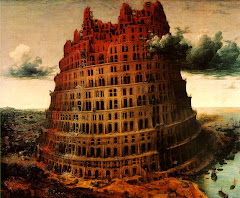
The hilarity coming from Bratislava last week must have had the Slovaks rolling in the aisles. Imagine their excitement over the chance to host the statesmen who, as leaders of the Free World, are working (and praying) daily to advance the noble cause of democracy worldwide. The high-mindedness of it all was so moving, and then the Bush European Road Show hit its dramatic peak when the earnest clown in the ten-gallon hat met with his soul-brother Vlad Putin for a little heart-to-heart, as reported in Slate:
"The public comments, at least, were mostly make-nice talk, but Bush also shared what he called 'concerns about Russia's commitment' to democracy. Putin in turn described democracy as 'our final choice.' He added, 'Some of the ideas that I heard from my partner I respect a lot. Some other ideas, I will not comment on. Thank you.' At that, says the NYT, 'Mr. Bush started to chuckle, and Mr. Putin winked back.'"
Thank you, Chuckles and Winkie, bring on the dancing girls, folks, don't worry about a thing and have a good time. Everything's in good hands, they've got big deals to make, big companies to merge, and empires to build, so the little issues can wait till after business is done. It really brings out the patriot in me, witnessing these historic occasions - think Congress of Vienna, think Versailles, think Yalta - when Great Men make Great Decisions on behalf of all us appreciative little people, and lap-dog columnists compare them to the revered figures of our proud past.
It made me want to barf when journalists of some integrity, like David Broder, cranked out the party line in his column just before inauguration day. The buzz word du jour from Karl Rove and Co. was 'Wilsonian', and I distinctly heard Woodrow Wilson turning over in his grave in Princeton. I can understand the ideological cheerleaders Krauthammer and Kristol repeating the mantra. But if Broder at the Post and Thomas Friedman at the Times want any access in the future, they'd better play along on this one. And of course they do, as responsible professionals, swallow their principles just this once in order to go along and get along.
Just like chanting any affirmation - okay, think Stewart Smalley, the Al Franken character: I'm good enough, I'm smart enough, and gosh darn it people like me! - if you repeat it over and over, people will believe it, which is as good as if it were true. [http://www.interluderetreat.com/meditate/affirm.htm] So repeat after me: the U.S. military and its corporate partners are taking over Iraq in order to spread the Good News of democracy. Again...
Monday, February 28, 2005


Monday, February 21, 2005
To blog or not to blog, that is the blogation
This thought has been rattling around long enough, and recent events make it timely. Which earth-shaking ideas - generated while in the shower, or stacking firewood, or sweeping the kitchen floor, or meditating - are suitable for blogging? [Answer: the ones generated while stacking wood, sweeping the floor, and meditating in the shower, of course.] I heard that someone, somewhere, got fired for writing something in their blog, the kind of rumor that could self-censor a million people instantly. So the reasoning goes: BE CAREFUL! Don't let it all hang out; edit yourself scrupulously - or as the far more subtle saying goes: Don't shit where you eat. Limits are not bad. As John Hartford said (in a song), "Style is based on limita-a-ation." No limits, no style.
In the middle of another, pre-election, conversation last year some time, Jack Spatula asked me which John Barth novel I was reading, and for some reason I wasn't ready to get into it just then (even though it was I who brought it up). The thing that was rattling around then was how Barth is always telling a story in which a character is telling a story, and sometimes the semi-autobiographical fictional characters are reflecting on the space between their present experience and their creative output - or lack thereof - and the tension it adds to both. Tension as in energy to put to use, but also tension as in angst, pain, doubt.
Barth makes it clear that he believes there is a difference between the life of the writer and the story, so let's not conflate the two by saying, postmodernly or post-structurally, that a life IS a narrative text, the present experience IS a creative act, and vice versa. While I'm not ready to go down that slippery slope, it does present some fun phenomenological and fictional possibilities - say THAT three times real fast! For now, I'm with Barth, pushing the literary envelope enough to poke some life into the fictional characters AND their doppelganger sitting at the keyboard, but keeping a permeable membrane between them.
Which brings me to what I really want to talk about, Hunter Thompson. How he lasted as long as he did is a wonder, but this week the world lost a singular character and a voice that won't be replaced any time soon. Hunter - can I call you Hunter? - knew no limits, or at least made it his business to transgress as many as possible, in public if possible, calling attention to the transgression as much as possible. Drug laws, normative ethics, common sense, journalistic conventions, race and class and party and genre lines. In short, he took pushing the writing envelope to new heights precisely by blurring or obliterating the distinction between the writer's life and the story.
It has become commonplace to say that he and others (somehow Tom Wolfe doesn't even belong in the same paragraph) stepped into the arena while reporting on it, rode on the Magic Bus, etc. etc. It took a really weird guy at a very weird time in Amerika to see that the bigger, richer, more vibrantly true story could only be told outside the lines, not by writing to please the editor, the publisher, the reader, the power broker, the patron, or to keep a job. Without being coy about it, Thompson played that angle for all it was worth, and he did it convincingly, sometimes despairingly, in the only way that could tap into the not-very-pretty stash in the trunk of Amerikan culture. Kids, do not try this at home.
In the middle of another, pre-election, conversation last year some time, Jack Spatula asked me which John Barth novel I was reading, and for some reason I wasn't ready to get into it just then (even though it was I who brought it up). The thing that was rattling around then was how Barth is always telling a story in which a character is telling a story, and sometimes the semi-autobiographical fictional characters are reflecting on the space between their present experience and their creative output - or lack thereof - and the tension it adds to both. Tension as in energy to put to use, but also tension as in angst, pain, doubt.
Barth makes it clear that he believes there is a difference between the life of the writer and the story, so let's not conflate the two by saying, postmodernly or post-structurally, that a life IS a narrative text, the present experience IS a creative act, and vice versa. While I'm not ready to go down that slippery slope, it does present some fun phenomenological and fictional possibilities - say THAT three times real fast! For now, I'm with Barth, pushing the literary envelope enough to poke some life into the fictional characters AND their doppelganger sitting at the keyboard, but keeping a permeable membrane between them.
Which brings me to what I really want to talk about, Hunter Thompson. How he lasted as long as he did is a wonder, but this week the world lost a singular character and a voice that won't be replaced any time soon. Hunter - can I call you Hunter? - knew no limits, or at least made it his business to transgress as many as possible, in public if possible, calling attention to the transgression as much as possible. Drug laws, normative ethics, common sense, journalistic conventions, race and class and party and genre lines. In short, he took pushing the writing envelope to new heights precisely by blurring or obliterating the distinction between the writer's life and the story.
It has become commonplace to say that he and others (somehow Tom Wolfe doesn't even belong in the same paragraph) stepped into the arena while reporting on it, rode on the Magic Bus, etc. etc. It took a really weird guy at a very weird time in Amerika to see that the bigger, richer, more vibrantly true story could only be told outside the lines, not by writing to please the editor, the publisher, the reader, the power broker, the patron, or to keep a job. Without being coy about it, Thompson played that angle for all it was worth, and he did it convincingly, sometimes despairingly, in the only way that could tap into the not-very-pretty stash in the trunk of Amerikan culture. Kids, do not try this at home.
Saturday, February 12, 2005
Water, part 2
Another nice, thick snowfall over the weekend gave me another chance to get out and shovel the walk. I didn't ski, and I didn't build a snowman in spite of perfect conditions, but I did take another look at that beautiful, wet, white stuff.
Rev. Susan told the kids in church a story about the hydrogen atoms in a glass of water. Apparently hydrogen atoms change very little in the course of time, so the hydrogen in the glass of water has been around for something like 13 billion years; we take part in the cycle of water by drinking it; containing it, and peeing it out; so a major portion of the little girl in the front row is 13,000,000,004 years old and a major portion of me just turned 13,000,000,054.
Hah! I feel just like a lad of 13,000,000,027!
Susan's purpose, I think, in talking about water in those terms is to get kids (including us big kids) to see themselves as physically and temporally connected to everybody and everything else in this fantastic hydrospheric cycle of life on Earth. And I do, when reminded.
Often this leads to metaphysical speculations and theories that I will not bore you with - unless prodded. And the putting to words of those speculations almost always bends them out of shape so much that they lose all sense, more reason to not go there. The thing I'm repeatedly reminded of - tangential to the watery, somatic existence on this watery, cosmic planet - is the futility of trying to name it, explain it, and pin it down with language.
Rev. Susan told the kids in church a story about the hydrogen atoms in a glass of water. Apparently hydrogen atoms change very little in the course of time, so the hydrogen in the glass of water has been around for something like 13 billion years; we take part in the cycle of water by drinking it; containing it, and peeing it out; so a major portion of the little girl in the front row is 13,000,000,004 years old and a major portion of me just turned 13,000,000,054.
Hah! I feel just like a lad of 13,000,000,027!
Susan's purpose, I think, in talking about water in those terms is to get kids (including us big kids) to see themselves as physically and temporally connected to everybody and everything else in this fantastic hydrospheric cycle of life on Earth. And I do, when reminded.
Often this leads to metaphysical speculations and theories that I will not bore you with - unless prodded. And the putting to words of those speculations almost always bends them out of shape so much that they lose all sense, more reason to not go there. The thing I'm repeatedly reminded of - tangential to the watery, somatic existence on this watery, cosmic planet - is the futility of trying to name it, explain it, and pin it down with language.
Friday, February 11, 2005
More Weight!
Keeping accounts: another way of talking about writing. Arthur Miller died today at age 89. He wrote arguably the greatest American play when he was in his thirties. He was a working-class Jew from New York who went to the University of Michigan, a place I have some attachment to. He worked hard, did well, took things seriously, wrote brilliantly, and succeeded in just about every way a man could. He was a big guy who didn't shirk the role of a man of letters during a national mudslide into fascist paranoia.
I heard on NPR that Miller built a shack in his yard so he would have a place to work, then wrote Death of a Salesman. I'd love to see the Lee J. Cobb version and then the Dustin Hoffman version, just to see how Willy Loman changed in a generation.
I'll never forget seeing The Crucible in Chicago in 1978 - I think it was Steppenwolf Theater - with my friend Edward Mellish. I told Edward that it struck me as just a bit Buddhist, the line near the end, "More weight! More weight!" when an old man, implicated only by his refusal to be a party to the witch-hunt, chooses to have stones piled on his chest and endure suffering rather than cause others to suffer. Edward thought it was more Christ-like, I guess, but Edward was very Episcopalian.
I came home by way of the credit union and closed my account, which still had $50 in it. A week ago I opened a new account at a different bank - open one, close one. I also sold a car this week but haven't found the replacement yet, so there's a missing piece in my account-keeping. I sat down at my desk to compute the balance, sort through some mail in preparation to do taxes, and separate the kids' documents from mine. I ate rice and beans, drank a Dead Guy Ale, put on a Benny Carter CD, started a fire in the stove, read a little, listened to Cowboy Junkies, worked out, walked the dog, and began to get back on an even keel in body and mind after a hectic and scattered day. Isn't this fascinating? I'm keeping accounts.
Just a disclaimer: I'm not Willy Loman, and my dad is not Willy Loman, although he was quite a salesman; I'm not Biff, and my son is not Biff, although he was quite an athlete. So it isn't personal in that sense. But sometimes when an artist passes, one who has made a difference, it's personal in a different way, especially when that artist stood up for something the way Arthur Miller stood up to McCarthyism.
I heard on NPR that Miller built a shack in his yard so he would have a place to work, then wrote Death of a Salesman. I'd love to see the Lee J. Cobb version and then the Dustin Hoffman version, just to see how Willy Loman changed in a generation.
I'll never forget seeing The Crucible in Chicago in 1978 - I think it was Steppenwolf Theater - with my friend Edward Mellish. I told Edward that it struck me as just a bit Buddhist, the line near the end, "More weight! More weight!" when an old man, implicated only by his refusal to be a party to the witch-hunt, chooses to have stones piled on his chest and endure suffering rather than cause others to suffer. Edward thought it was more Christ-like, I guess, but Edward was very Episcopalian.
I came home by way of the credit union and closed my account, which still had $50 in it. A week ago I opened a new account at a different bank - open one, close one. I also sold a car this week but haven't found the replacement yet, so there's a missing piece in my account-keeping. I sat down at my desk to compute the balance, sort through some mail in preparation to do taxes, and separate the kids' documents from mine. I ate rice and beans, drank a Dead Guy Ale, put on a Benny Carter CD, started a fire in the stove, read a little, listened to Cowboy Junkies, worked out, walked the dog, and began to get back on an even keel in body and mind after a hectic and scattered day. Isn't this fascinating? I'm keeping accounts.
Just a disclaimer: I'm not Willy Loman, and my dad is not Willy Loman, although he was quite a salesman; I'm not Biff, and my son is not Biff, although he was quite an athlete. So it isn't personal in that sense. But sometimes when an artist passes, one who has made a difference, it's personal in a different way, especially when that artist stood up for something the way Arthur Miller stood up to McCarthyism.
Tuesday, February 08, 2005
Personalize This!
All the lovely worker-friendly rhetoric being tossed around Washington (and several red states with blue senators) to sell the hijacking of Social Security makes you wonder how far they'll go - the private interests who have invested heavily in the current quasi-public regime - in privatizing the public sector. Why have a public sector at all in an "ownership society" if corporations can pull a friendly takeover of government functions and make a tidy profit? Move over, Jonathan Swift, I have a Modest Proposal.
Because we're so darn compassionate, let's "personalize" the Departments of Education, Labor, Interior, Energy, and Agriculture. Everybody knows the holy trinity of Capital, Competition, and Market Forces automatically create better schools for those who can afford them, a grovelling and obedient workforce, more efficient exploitation of wilderness wasteland, and corporate dominion over the flora and fauna. No more excessive regulation, no more bureaucratic red tape. Let the industry experts turn those backward institutions into lean, mean profit machines. That way, the people who have earned the right to enjoy schools, employment benefits, parks, natural resource extraction, and farm production can buy them free of government interference. Oh. They already did? Sorry.
Moving right along, a bold strategy for the twenty-first century would include "personalizing" the EPA, FDA, Health and Human Services, Medicare, Medicaid, Treasury, and best of all, the Justice Department. Rather than just using the old revolving door trick where corporate executives trade places with regulatory officials, just eliminate the guvmint middleman and let manufacturers of food, drugs, cars, apparel, electronics, and widgets self-regulate, thus freeing up resources for making, selling, and consuming more stuff. The costly products and services - like legal and medical expertise - would be readily available to those who deserve and can afford it, without the inherent inefficiency of providing it free to those who can't pay. What? You want a hand-out? Buy your own hospital.
But the crown jewel of this new, improved, profitable government would be the personalized State and Defense Departments. Foreign policy and the military have been in the hands of the Washington elite for too long! Citizens will have the option of investing part of their earnings in the next War to Spread Democracy (WSD), or peace talks for you low-stakes investors, or arms deals with paying customers in cash-rich countries - now there's a sure-fire investment. Personalized foreign policy means your dollars buy shares in the New American Century, and as a stakeholder in freedom, you can help send some other poor schmuck out there in whatever equipment is handy to do the dirty work for you.
Because we're so darn compassionate, let's "personalize" the Departments of Education, Labor, Interior, Energy, and Agriculture. Everybody knows the holy trinity of Capital, Competition, and Market Forces automatically create better schools for those who can afford them, a grovelling and obedient workforce, more efficient exploitation of wilderness wasteland, and corporate dominion over the flora and fauna. No more excessive regulation, no more bureaucratic red tape. Let the industry experts turn those backward institutions into lean, mean profit machines. That way, the people who have earned the right to enjoy schools, employment benefits, parks, natural resource extraction, and farm production can buy them free of government interference. Oh. They already did? Sorry.
Moving right along, a bold strategy for the twenty-first century would include "personalizing" the EPA, FDA, Health and Human Services, Medicare, Medicaid, Treasury, and best of all, the Justice Department. Rather than just using the old revolving door trick where corporate executives trade places with regulatory officials, just eliminate the guvmint middleman and let manufacturers of food, drugs, cars, apparel, electronics, and widgets self-regulate, thus freeing up resources for making, selling, and consuming more stuff. The costly products and services - like legal and medical expertise - would be readily available to those who deserve and can afford it, without the inherent inefficiency of providing it free to those who can't pay. What? You want a hand-out? Buy your own hospital.
But the crown jewel of this new, improved, profitable government would be the personalized State and Defense Departments. Foreign policy and the military have been in the hands of the Washington elite for too long! Citizens will have the option of investing part of their earnings in the next War to Spread Democracy (WSD), or peace talks for you low-stakes investors, or arms deals with paying customers in cash-rich countries - now there's a sure-fire investment. Personalized foreign policy means your dollars buy shares in the New American Century, and as a stakeholder in freedom, you can help send some other poor schmuck out there in whatever equipment is handy to do the dirty work for you.
Monday, January 31, 2005
It was a very good year
When I was 27, it was a very good year. It was a very good year for Southern girls to cast caution to the wind, move to Chicago with a Midwestern boy, live in a basement apartment in Rogers Park, walk to the Howard Street EL, get Squeak the cat, teach and study yoga on Bryn Mawr Ave., get befriended by Durga, clean houses for a living, make salads and friends at the Heartland Cafe, run at the Loyola track, run the Chicago Marathon, get married.
It was a very good year for Midwestern boys to ride the EL up to Pioneer Press and paste up ads for suburban weeklies, ride the Evanston Express down to the Loop to type and make copies for Ma Bell, walk to the lakefront for lunch, wander the Art Institute on Free Thursday, go to the public library on Michigan Avenue, watch movies with Edward Mellish, run into Corky Siegel at the beach, eat Mexican at La Choza, get accepted at Oberlin, get married.
It was a very good year to go to t'ai chi classes on Dempster Street every Saturday, learn Basic Movement, study the Ch'en form, drink Professor Huo's jasmine tea, hang out after class, get befriended by DJ and Dick, read their books, listen to their nutritional advice, pester them with questions, witness Professor's painting demonstration, decide to go back to school in physical education, receive a painting as a wedding gift.
As of this month it's been 27 years since those life-altering days enduring a Chicago winter and enjoying a Chicago summer. I still do Basic Movement but stopped practicing and forgot the Ch'en form after four years. I learned a Yang form, then another one, then another one, and I still practice it (the second one). I took up ch'i-kung and do that every day now. I still repeat the starting instructions from January 1978 on occasion, and it still makes a difference:
Assume the head to be suspended from above, face the front, mouth closed, tongue touching the roof, breathe naturally through the nose, let the shoulders and elbows sink down with arms, hands, and fingers naturally extended at your sides, relax the body, clear the mind, breathe deeply, inhale, exhale.
A few things have changed since those days. Now there are two young adults, out in the world on their own adventures, whose DNA derives directly from mine and Gven Golly's. If I were a total Romantic, I would say that the story of the second 27 was written in that one Chicago year when Gven and Sven crystallized as a couple in the heat and cold of the Windy City. But it's more complicated than that, so I'll just spill my pent-up nostalgia and appreciation in this space and get back to work on the next cycle of nine times three.
It was a very good year for Midwestern boys to ride the EL up to Pioneer Press and paste up ads for suburban weeklies, ride the Evanston Express down to the Loop to type and make copies for Ma Bell, walk to the lakefront for lunch, wander the Art Institute on Free Thursday, go to the public library on Michigan Avenue, watch movies with Edward Mellish, run into Corky Siegel at the beach, eat Mexican at La Choza, get accepted at Oberlin, get married.
It was a very good year to go to t'ai chi classes on Dempster Street every Saturday, learn Basic Movement, study the Ch'en form, drink Professor Huo's jasmine tea, hang out after class, get befriended by DJ and Dick, read their books, listen to their nutritional advice, pester them with questions, witness Professor's painting demonstration, decide to go back to school in physical education, receive a painting as a wedding gift.
As of this month it's been 27 years since those life-altering days enduring a Chicago winter and enjoying a Chicago summer. I still do Basic Movement but stopped practicing and forgot the Ch'en form after four years. I learned a Yang form, then another one, then another one, and I still practice it (the second one). I took up ch'i-kung and do that every day now. I still repeat the starting instructions from January 1978 on occasion, and it still makes a difference:
Assume the head to be suspended from above, face the front, mouth closed, tongue touching the roof, breathe naturally through the nose, let the shoulders and elbows sink down with arms, hands, and fingers naturally extended at your sides, relax the body, clear the mind, breathe deeply, inhale, exhale.
A few things have changed since those days. Now there are two young adults, out in the world on their own adventures, whose DNA derives directly from mine and Gven Golly's. If I were a total Romantic, I would say that the story of the second 27 was written in that one Chicago year when Gven and Sven crystallized as a couple in the heat and cold of the Windy City. But it's more complicated than that, so I'll just spill my pent-up nostalgia and appreciation in this space and get back to work on the next cycle of nine times three.
Saturday, January 22, 2005
Stopping by condos on a snowy evening
Saturday was beautiful, and the fresh snow that fell overnight gave me a good excuse to drag out my old, beat-up cross-country skis and get my butt outside. After a cup of coffee and some leftover pizza, I scrawled new wax on my scratched-up wooden skis and trudged across the field to the bike trail. There was enough snow so that the paved surface was fine, and I found that if I stayed to one side I could pole with one arm on the unpaved shoulder. Light wind, temperature in the 20s, nice dry snow, nearly ideal conditions. But where could I go in Methodisttown?
Rather than drive out to Alumni Creek Reservoir, where there are groomed trails, or a golf course where there are hills, I took the path of least resistance - and it has made all the difference - the bike trail that used to be the Conrail tracks. It's nothing special. It's flat, and it crosses a few streets going north to Maxtown Road or south to State Street. There are a few trees along one side and fences, warehouses, back yards, and a couple of open fields on the other. Past County Line there is a wooded stretch beside a new upscale housing development with street names like Nature Trail, where it felt quite peaceful. A big V-shaped flock of Canada geese honked by overhead, and I acknowledged them with outstretched arms. I ignored the people and their snow-blowers.
It felt good to stride and glide, stride and glide, hardly poling at all, and I found a rhythm I could maintain without getting tired. I got back an hour and a half later satisfied, did the usual Saturday chores, shoveled the walk, and sat down to watch the snow falling heavier. It's hypnotic. The pea soup is ready, and bread is in the oven. I have firewood to bring in, compost to take out, and miles to go before I sleep. Ha ha.
Rather than drive out to Alumni Creek Reservoir, where there are groomed trails, or a golf course where there are hills, I took the path of least resistance - and it has made all the difference - the bike trail that used to be the Conrail tracks. It's nothing special. It's flat, and it crosses a few streets going north to Maxtown Road or south to State Street. There are a few trees along one side and fences, warehouses, back yards, and a couple of open fields on the other. Past County Line there is a wooded stretch beside a new upscale housing development with street names like Nature Trail, where it felt quite peaceful. A big V-shaped flock of Canada geese honked by overhead, and I acknowledged them with outstretched arms. I ignored the people and their snow-blowers.
It felt good to stride and glide, stride and glide, hardly poling at all, and I found a rhythm I could maintain without getting tired. I got back an hour and a half later satisfied, did the usual Saturday chores, shoveled the walk, and sat down to watch the snow falling heavier. It's hypnotic. The pea soup is ready, and bread is in the oven. I have firewood to bring in, compost to take out, and miles to go before I sleep. Ha ha.
Wednesday, January 19, 2005
We shall overcome
So I sat in church and listened to an audio tape of Martin Luther King speaking to a large gathering in Washington, August 28, 1963 - I remember the date because it was my sister Jo's sixteenth birthday - and listened to the choir sing about freedom, listened to Rev. Susan talk about the years of work, meetings, and training that led up to Rosa Parks refusing to go to the back of the bus, and how the moderate civil rights groups wouldn't support the Montgomery bus boycott. When the congregation stood to sing "We Shall Overcome," I got one line into it and my mouth stopped working. It's happened before. I tried again, and my hands started shaking holding the hymnal, and my voice wouldn't sing a complete line or verse: We shall overcome...We'll walk hand in hand...We will live in peace. The rest of the congregation did just fine without me.
What gets stuck in my fifth chakra? It's partly just my pessimism about large groups of people getting along with mutual respect; I don't see it happening, even among small groups of like-minded people, let alone subcultures who see each other as the evil, subhuman, or inferior 'other'. And part of that 'otherness' is the belief that we're all in a zero-sum game, where my success depends on your defeat. Dominate or be dominated. Not that I act that way - no, this is other people I'm talking about.
Another problem is that my fourth and sixth chakras agree that it matters, and overcoming, living in peace, etc., deserves to be taken seriously. Always a dangerous step. Once committed to doing something about it, I could turn out to be wrong; life could be one big social darwinian game of domination. Or I could fail miserably, and personal humiliation is never fun. And it is personal, because I'm talking about overcoming not just Ashcroft and Bull Connor and George Wallace and Joe McCarthy (the bad guys) but the fear and pettiness and hubris in myself, my family, and my friends (the good guys). It's a lot of work. I'm tired already. And this poor attempt at writing it out is another fifth-chakra breakdown.
What gets stuck in my fifth chakra? It's partly just my pessimism about large groups of people getting along with mutual respect; I don't see it happening, even among small groups of like-minded people, let alone subcultures who see each other as the evil, subhuman, or inferior 'other'. And part of that 'otherness' is the belief that we're all in a zero-sum game, where my success depends on your defeat. Dominate or be dominated. Not that I act that way - no, this is other people I'm talking about.
Another problem is that my fourth and sixth chakras agree that it matters, and overcoming, living in peace, etc., deserves to be taken seriously. Always a dangerous step. Once committed to doing something about it, I could turn out to be wrong; life could be one big social darwinian game of domination. Or I could fail miserably, and personal humiliation is never fun. And it is personal, because I'm talking about overcoming not just Ashcroft and Bull Connor and George Wallace and Joe McCarthy (the bad guys) but the fear and pettiness and hubris in myself, my family, and my friends (the good guys). It's a lot of work. I'm tired already. And this poor attempt at writing it out is another fifth-chakra breakdown.
Monday, January 17, 2005
January 20
I think I ought to do something, but I'm not sure what.
Show up on Pennsylvania Avenue, naked, holding a sign, mooning the procession while wearing jester's cap and bells, turning my back along with other dissenters, wearing black, wearing a flight suit, declaring "Mission Accomplished," election stolen, thanking Kenneth Blackwell, thanking Kenneth Lay, burning the Patriot Act, burning the flag, packing for Guantanamo, I dunno.
Write my lock-step congressman, Pat Tiberi, that would make a big difference, or my "moderate" senators, Voinovich and DeWine, write a letter to the Dispatch, write an outraged blog, write a manifesto, write a semiautobiographical coming-of-age bildungsromantic novel, write a taiji manual, revise a world history book, build a better paragraph, make the world safe for The New American Century?
Pray for peace, pray for divine intervention, bless our troops, bless their troops, meditate in silence, withdraw from public life, run for local office, run for cover, just run?
Send money to the DNC, send money to Impeach.org, send money to MoveOn, send money to Sumatra, send money to my kids, start a private social security account, invest in Halliburton/ExxonMobil/Shell, go to hell, buy a Hummer, kill my television, spend nothing?
Open to suggestion.
Show up on Pennsylvania Avenue, naked, holding a sign, mooning the procession while wearing jester's cap and bells, turning my back along with other dissenters, wearing black, wearing a flight suit, declaring "Mission Accomplished," election stolen, thanking Kenneth Blackwell, thanking Kenneth Lay, burning the Patriot Act, burning the flag, packing for Guantanamo, I dunno.
Write my lock-step congressman, Pat Tiberi, that would make a big difference, or my "moderate" senators, Voinovich and DeWine, write a letter to the Dispatch, write an outraged blog, write a manifesto, write a semiautobiographical coming-of-age bildungsromantic novel, write a taiji manual, revise a world history book, build a better paragraph, make the world safe for The New American Century?
Pray for peace, pray for divine intervention, bless our troops, bless their troops, meditate in silence, withdraw from public life, run for local office, run for cover, just run?
Send money to the DNC, send money to Impeach.org, send money to MoveOn, send money to Sumatra, send money to my kids, start a private social security account, invest in Halliburton/ExxonMobil/Shell, go to hell, buy a Hummer, kill my television, spend nothing?
Open to suggestion.
Monday, January 10, 2005
Water
So I'm out in the back yard blackening my fingers with the sap from pine branches that snapped and fell during the recent ice storm. It's 50 degrees and sunny outside - in January, in Ohio - and I'm digging the chance to be outside, breathe fresh air, clean up the yard, strip the branches, and use the needles (in Georgia it's "pine straw") to mulch flower beds. It's a win-win situation. Brought about by a Christmas Eve snowstorm, followed by an ice storm that left half a million people without power for days. Followed by a week of rain that flooded several river-valley communities that are still trying to dry out. And we in middle Amerika got off easy. If weather is a global phenomenon, our storms were connected to more severe seismic events on the opposite side of the planet that produced truly awesome, terrible waves.
I'm just imagining, without meteorological facts to back it up, a sudden crunching crack in the crust at the bottom of the Indian Ocean, releasing energy that had been building up for a long time, that pushed real hard against a huge mass of water in direct contact with said crust. Like a chiropractic adjustment that alters the position of all the tissues around it, this local jolt sends a wave radiating outward that doesn't stop until it hits something solid, like half of South and Southeast Asia and part of Africa. But it doesn't stop there either, because the shock waves, like the butterfly effect, radiate through the ground and into the atmosphere, as well as through the ocean, and pretty soon I'm mulching my garden with volunteer pinestraw. There but for fortune.
So I ask you, dear reader, am I hallucinating from the effects of this really great pine tar?
I'm just imagining, without meteorological facts to back it up, a sudden crunching crack in the crust at the bottom of the Indian Ocean, releasing energy that had been building up for a long time, that pushed real hard against a huge mass of water in direct contact with said crust. Like a chiropractic adjustment that alters the position of all the tissues around it, this local jolt sends a wave radiating outward that doesn't stop until it hits something solid, like half of South and Southeast Asia and part of Africa. But it doesn't stop there either, because the shock waves, like the butterfly effect, radiate through the ground and into the atmosphere, as well as through the ocean, and pretty soon I'm mulching my garden with volunteer pinestraw. There but for fortune.
So I ask you, dear reader, am I hallucinating from the effects of this really great pine tar?
Thursday, December 30, 2004
The country life
Nothing could be more mundane, and that's why I like it. The chickens are securely put to bed (or to roost) for the night, with fresh water, food, and a rock in front of the coop door. I'm enjoying a bowl of rice and beans with a rum and OJ, beginning chapter 8 of The Spy Who Came In From the Cold. Gven Golly is in town teaching her Tuesday night yoga class, and I have the house-sitting to myself for a while. So I take a walk around the yard in the crusty snow, work out a little on the broad front porch of our friends' log house, listen to the Mothers, the Who, and the Clash on their excellent stereo. It's remarkably comfortable here, more evenly heated than our brick antique in town, with doors and windows that are snug and tight. The weather has gotten warmer after last week's snow and ice storms and this week's subzero nights. When the wind blows, it knocks the melting ice off the roof and trees, and the strange house makes lots of odd noises.
Gven and I talked about doing something like this ourselves in ten years or so, moving further away from the city and getting a couple of animals. Something about being here opened up a kind of conversation we haven't had in a long time. Sitting across Lulu's table facing each other in this big country kitchen with my wife of 26 years and friend of 28 - more than half my life - we talked about where we were back in '76, '77, '78. Part of that time was spent house-sitting in a friend's log cabin in the snowy hills of upstate New York, using their kitchen, woodstove, and bed (but no plumbing, no chickens, and no Clash). A lot has happened since then, and now our older child is almost Gven's age back then.
We had a great week. It didn't go exactly as planned, of course, but what adventure does? I didn't have the time away from work to spend leisurely days out at the ranch. My ancient nordic skis stayed in the car all week, with no time or opportunity to strap them to my feet and take off across a field. Our offspring didn't want to shelve their own plans to trek out route 3 and visit us and the chickens - not even for a couple of hours! But Gven Golly and I did celebrate our anniversary in a manner befitting our life - with a bottle of red wine and a take-and-bake pizza from Mama Mimi's - after putting the lovely chickens to roost for the night.
Gven and I talked about doing something like this ourselves in ten years or so, moving further away from the city and getting a couple of animals. Something about being here opened up a kind of conversation we haven't had in a long time. Sitting across Lulu's table facing each other in this big country kitchen with my wife of 26 years and friend of 28 - more than half my life - we talked about where we were back in '76, '77, '78. Part of that time was spent house-sitting in a friend's log cabin in the snowy hills of upstate New York, using their kitchen, woodstove, and bed (but no plumbing, no chickens, and no Clash). A lot has happened since then, and now our older child is almost Gven's age back then.
We had a great week. It didn't go exactly as planned, of course, but what adventure does? I didn't have the time away from work to spend leisurely days out at the ranch. My ancient nordic skis stayed in the car all week, with no time or opportunity to strap them to my feet and take off across a field. Our offspring didn't want to shelve their own plans to trek out route 3 and visit us and the chickens - not even for a couple of hours! But Gven Golly and I did celebrate our anniversary in a manner befitting our life - with a bottle of red wine and a take-and-bake pizza from Mama Mimi's - after putting the lovely chickens to roost for the night.
Thursday, December 23, 2004
Why I love the rec center
It's Saturday morning in early December, and youth basketball leagues haven't started yet, so the gym is strangely quiet when I came out of taiji class. There happens to be an old, worn-out ball in the corner, and it called out to me. Since I don't have to be anywhere else right now, I pick up the ball, take a shot. I have no legs and no touch; I haven't played in over a year, but there's nobody here but me, the ball, the hoop, the floor.
Paradise. Pair o' dice.
My first few shots are rough, but soon I find my stroke, and the jump shots start falling. A spin move comes out of nowhere, a follow shot with the left hand, and a hook off the board. The hardwood in the old brick gym resonates with the drum-like sound of the ball on the floor. I start to find my legs enough to elevate a little; both the backboard and the rim are forgiving, and I make more than I miss. Heating up now, I take off my sweatshirt, and movements become freer, ball-handling easier, limbs looser and everything more integrated as I find a rhythm. I'm hitting baseline jumpers, one, two, three in a row, bank shots from the key, and floating lay-ins.
Finally a bunch of young guys saunter in, walk the length of the court, check me out, walk out, come back with a ball, and start shooting at the other end. One of the beauties of the court: it's a two-part universe where two private games can go on simultaneously. A funny thing happened then: no longer in my own world remembering moves I learned in my Detroit driveway in the 60s, I suddenly lost my legs and my touch and couldn't buy a basket. A rational person my age would have yielded to the warning signals coming from my left thigh every time I went up, called it fatigue or an old injury or whatever, and gone home. A few more people came to stand by the door: a younger boy, a couple of teenage girls, a woman with a baby.
I kept shooting, just took a little more time to retrieve each stray rebound, and I got it back - the stroke that drops the ball cleanly through the net, the ankle-knee-hip-spine-shoulder-elbow-wrist uncoiling that spins the ball through the hoop, and the concentration to look the ball into the hole. Eureka or deja-vu or amen.
Eventually I was ready to pack it in, and the young guys were playing 3-on-3 half-court. One short-haired white kid, one Asian kid in baggy pants, four black kids in black shoes, black shorts, black Nike shirt, black head-band, black dew-rag. When I sat down to watch, they started playing full-court and gradually showed their knowledge of the game: a post-up here, a back-door, pick-and-roll, or give-and-go there, moving without the ball, a nice inside pass, good position on a rebound - even some defense. It's a beautiful game when it's played by people who respect it, themselves, and each other.
After a while, the director comes in and tells them they have to take their game downstairs to the other gym (the rec center has TWO gyms!) because it's time for the girls team to practice. Two tall, athletic, serious men enter the gym carrying clipboards and bags of balls - the coaches. I take my own bag and my endorphins and head home, but stop at the deskon my way out to thank the director for the time to play.
Paradise. Pair o' dice.
My first few shots are rough, but soon I find my stroke, and the jump shots start falling. A spin move comes out of nowhere, a follow shot with the left hand, and a hook off the board. The hardwood in the old brick gym resonates with the drum-like sound of the ball on the floor. I start to find my legs enough to elevate a little; both the backboard and the rim are forgiving, and I make more than I miss. Heating up now, I take off my sweatshirt, and movements become freer, ball-handling easier, limbs looser and everything more integrated as I find a rhythm. I'm hitting baseline jumpers, one, two, three in a row, bank shots from the key, and floating lay-ins.
Finally a bunch of young guys saunter in, walk the length of the court, check me out, walk out, come back with a ball, and start shooting at the other end. One of the beauties of the court: it's a two-part universe where two private games can go on simultaneously. A funny thing happened then: no longer in my own world remembering moves I learned in my Detroit driveway in the 60s, I suddenly lost my legs and my touch and couldn't buy a basket. A rational person my age would have yielded to the warning signals coming from my left thigh every time I went up, called it fatigue or an old injury or whatever, and gone home. A few more people came to stand by the door: a younger boy, a couple of teenage girls, a woman with a baby.
I kept shooting, just took a little more time to retrieve each stray rebound, and I got it back - the stroke that drops the ball cleanly through the net, the ankle-knee-hip-spine-shoulder-elbow-wrist uncoiling that spins the ball through the hoop, and the concentration to look the ball into the hole. Eureka or deja-vu or amen.
Eventually I was ready to pack it in, and the young guys were playing 3-on-3 half-court. One short-haired white kid, one Asian kid in baggy pants, four black kids in black shoes, black shorts, black Nike shirt, black head-band, black dew-rag. When I sat down to watch, they started playing full-court and gradually showed their knowledge of the game: a post-up here, a back-door, pick-and-roll, or give-and-go there, moving without the ball, a nice inside pass, good position on a rebound - even some defense. It's a beautiful game when it's played by people who respect it, themselves, and each other.
After a while, the director comes in and tells them they have to take their game downstairs to the other gym (the rec center has TWO gyms!) because it's time for the girls team to practice. Two tall, athletic, serious men enter the gym carrying clipboards and bags of balls - the coaches. I take my own bag and my endorphins and head home, but stop at the deskon my way out to thank the director for the time to play.
Subscribe to:
Posts (Atom)